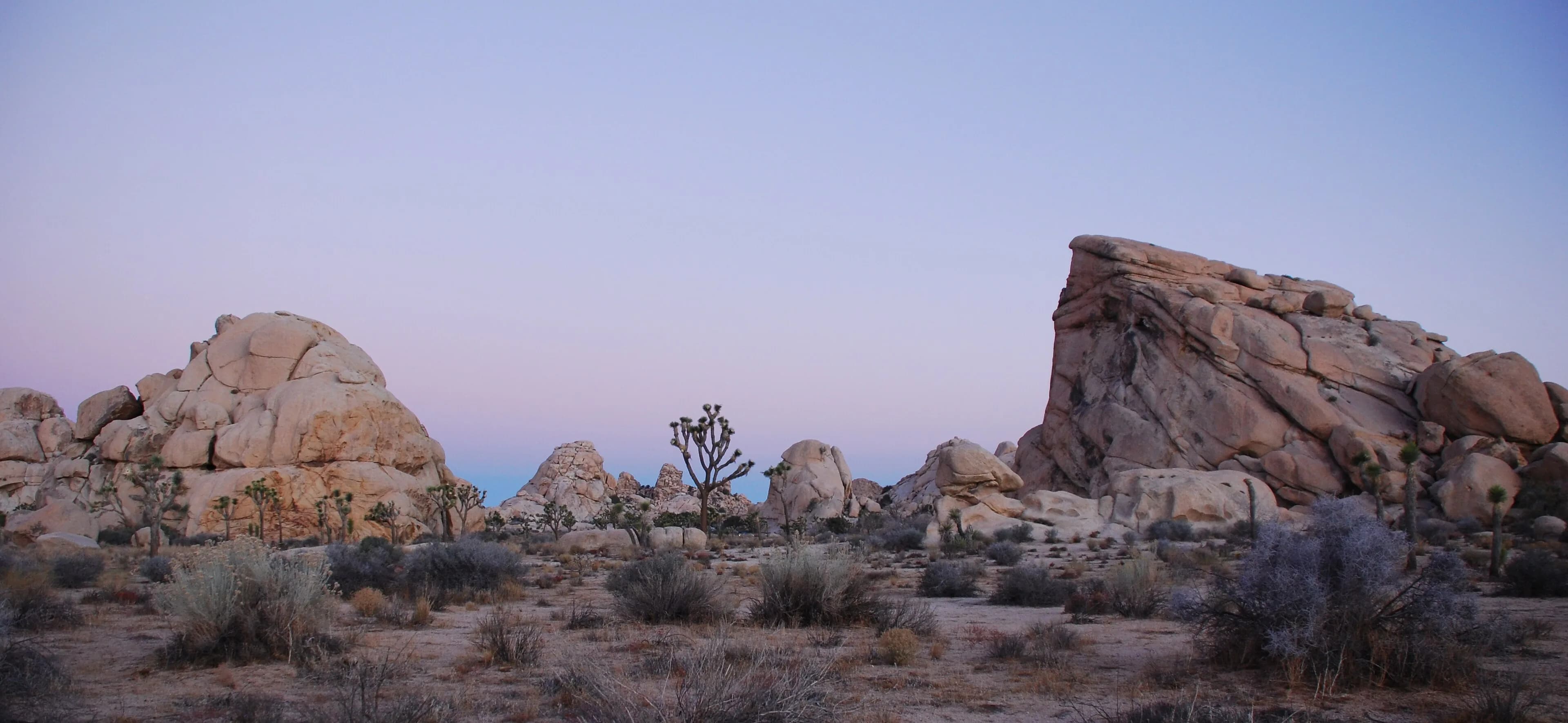
Joshua Tree is strange and still and a little bit eerie in the best possible way. The trees themselves look like they were drawn by someone who had never seen a tree — arms reaching in every direction, no leaves, covered in spines. The boulders are enormous and smooth and warm to the touch. At night, when the stars come out, it becomes something else entirely.
The Mojave and Sonoran deserts collide here, creating a landscape unlike anywhere else on Earth. The Joshua trees (actually a species of yucca) exist only in this narrow elevation band of the Mojave. The Cholla Cactus Garden at sunset is a half-mile of cacti that seem to glow orange from inside. The night sky is among the clearest in the Lower 48.
Make this stop yours
Skip it, leave a note, or swap in something else. Saved to your shared plan.
Add your own stops
Found another place worth a visit around Joshua Tree National Park, CA? Add it and it joins your trip and maps.
The moment
Lying on a flat boulder in the park on a clear night watching the Milky Way stretch from one horizon to the other. More stars than you have ever seen in your life. More than you knew existed. Let your eyes adjust for 15 minutes and it gets more extraordinary.
The classic mistake
Going to Joshua Tree in July or August. Temperatures exceed 115°F. It is genuinely dangerous. This stop belongs to October through April.
The photograph
Cholla Cactus Garden at sunset — position yourself so the setting sun is behind you and the cacti are backlit. Each spine glows individually. The effect is impossible to believe until you see it.
Skip it if
You're visiting in high summer. Come back another time.
Don’t skip it if
You have never seen a truly dark sky. A night here will recalibrate what you thought the universe looked like.
How long do you need?
2 hours: Cholla Cactus Garden at sunset + one boulder area. Half day: add Skull Rock trail and Hidden Valley. Full day: everything plus nighttime stargazing.
What to ask
Ask a ranger about the Joshua tree's relationship with the yucca moth — the tree cannot reproduce without it, and the moth cannot survive without the tree. It's one of the most elegant partnerships in nature and tells you something about how this desert works.
🍂 This season · Fall / Winter
October through February is the ideal season — mild days, cold clear nights, and the Milky Way on any cloudless evening.
Entry fee
$30/vehicle (7-day pass).
Gas
Twentynine Palms at the north entrance; Palm Springs 40 min south for abundant options.
Don't miss eating
Date shakes at Hadley Fruit Orchards near Cabazon, CA — the Coachella Valley produces some of the world's finest Medjool dates, and the milkshake made from them is unlike anything you can get elsewhere.
Websitenps.gov/jotr
Average weather, all twelve months
| Jan | Feb | Mar | Apr | May | Jun | Jul | Aug | Sep | Oct | Nov | Dec | |
|---|---|---|---|---|---|---|---|---|---|---|---|---|
| High | 60° | 64° | 71° | 80° | 90° | 99° | 106° | 104° | 98° | 86° | 71° | 62° |
| Low | 36° | 39° | 44° | 51° | 60° | 68° | 76° | 74° | 68° | 57° | 44° | 37° |
| Rain/Snow | 0.8" | 0.8" | 0.5" | 0.2" | 0.1" | 0.0" | 0.4" | 0.6" | 0.3" | 0.3" | 0.3" | 0.5" |